

It’s a reasonable starting point for a conversation about B2B marketing performance. If the business isn’t generating enough qualified pipeline, increasing the number of potential opportunities is an obvious consideration.
But it’s not always the right solution.
One of the things I try to establish when speaking to prospective clients is whether the business genuinely needs more demand, or whether it’s already attracting suitable buyers who aren’t progressing into commercial opportunities.
Those are very different problems.
If the business isn’t reaching enough of its ideal customers, improving Search visibility or Paid acquisition may be the priority.
If it’s attracting relevant organisations but too few are making enquiries, the constraint may sit in how the business communicates its value and supports evaluation.
And if suitable enquiries are arriving but rarely becoming qualified opportunities, the problem may occur after the initial conversion.
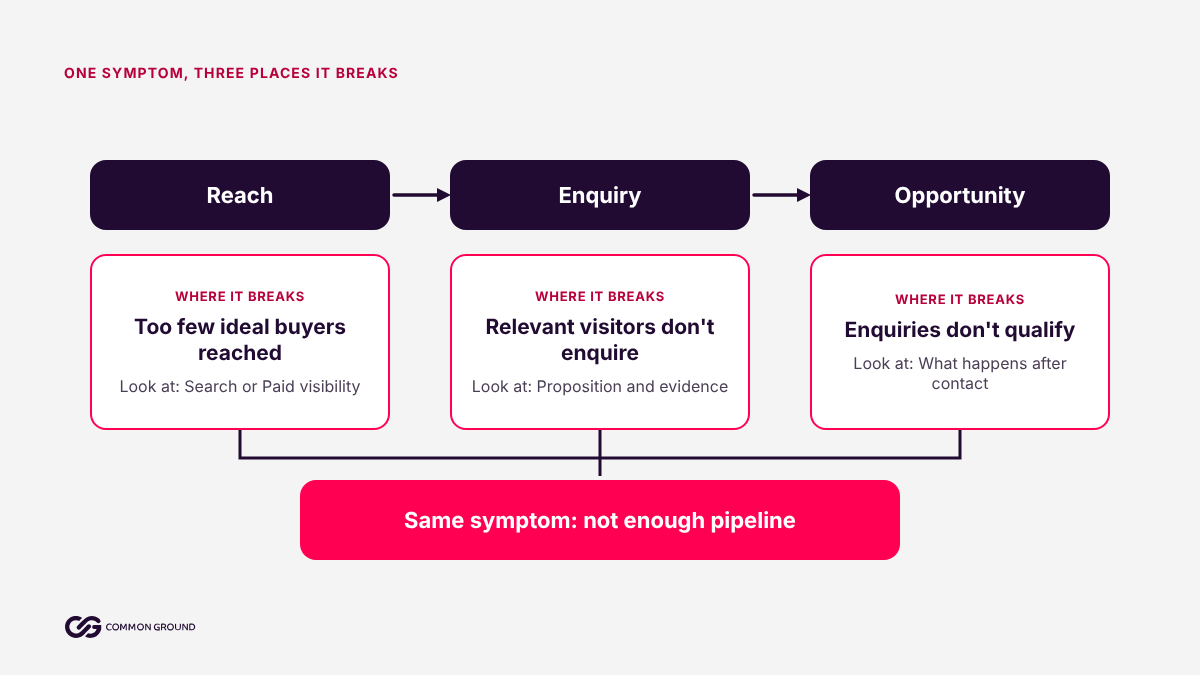
In each situation, the business experiences the same outcome: insufficient pipeline.
But increasing lead volume won’t necessarily address the underlying cause.
Before investing in more acquisition, it’s worth understanding where suitable buyers are being lost.
Key Takeaways:
- Find where buyers are lost before buying more leads. The same pipeline gap can come from reaching too few buyers, too few enquiries, or too few qualified opportunities.
- Check demand quality first. If the right organisations are already arriving, more of the same traffic only raises the cost of the problem.
- Relevant buyers still need a reason to choose you. An unclear proposition or missing proof can stop good visitors from enquiring.
- Answer buyers’ questions before asking for contact. Case studies, a clear approach and who you work with help buyers build the confidence to enquire.
- Some constraints sit after the enquiry. Qualification, follow-up and differing views of fit can stall good leads, so feed what sales learns back into targeting.
First, establish whether demand quality is actually the problem
When lead generation is underperforming, it’s tempting to focus immediately on targeting.
Perhaps the wrong keywords are attracting visitors. Paid campaigns may be reaching unsuitable audiences. The content strategy may be generating interest from people who aren’t realistic buyers.
Those are legitimate possibilities.
But they shouldn’t be assumed.
A business may already be attracting organisations that match its ideal customer profile, operate in relevant sectors and have genuine reasons to consider its services.
The question then becomes what happens to those organisations after they arrive.
Are they making enquiries?
Are those enquiries being qualified?
Are suitable opportunities progressing into meaningful commercial discussions?
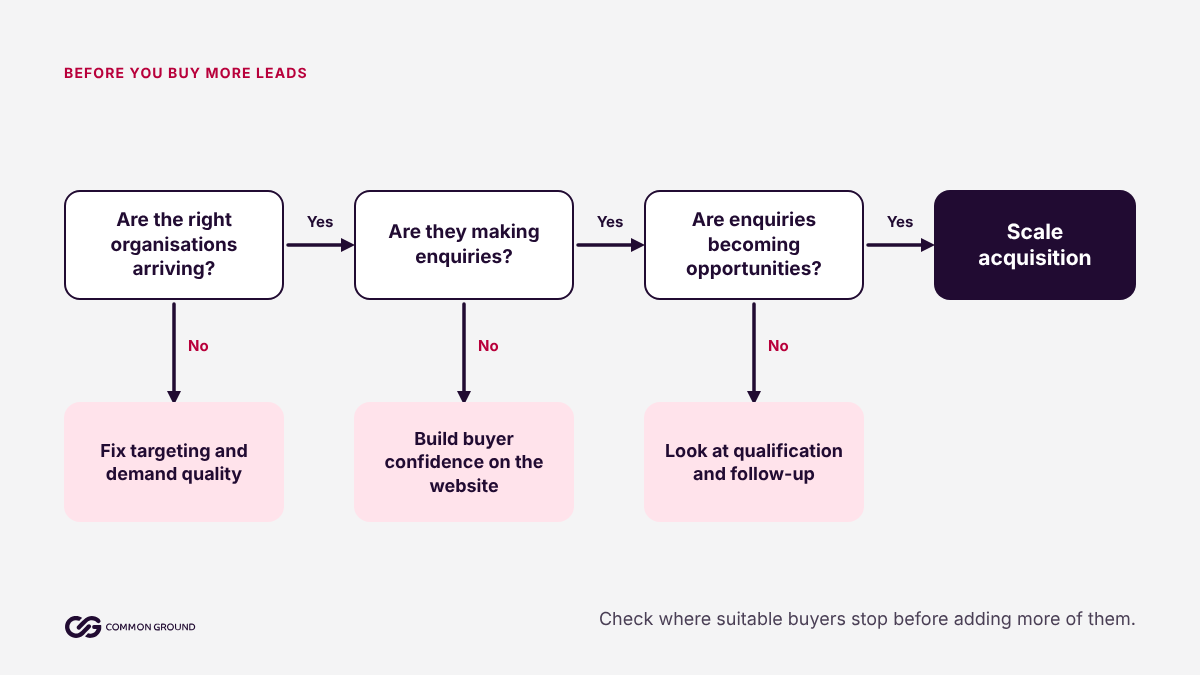
This distinction matters because acquisition performance can look weak for reasons that have little to do with the quality of the audience being reached.
For example, a Paid campaign may generate relatively few enquiries despite reaching a commercially relevant audience.
That could indicate poor targeting.
But it could also mean the website isn’t giving buyers enough confidence to take the next step.
The response should depend on which explanation the evidence supports.
If suitable buyers are already arriving, generating more of the same traffic may simply increase the cost of an unresolved problem.
A relevant buyer still needs a reason to choose you
Reaching the right audience is only part of the acquisition challenge.
The business also needs to communicate why it’s a credible option for that audience.
This becomes particularly important in established B2B markets where several suppliers appear capable of delivering similar services.
A potential buyer may arrive through a commercially relevant search, recognise that the business offers what they need and still leave without making contact.
That doesn’t necessarily indicate a lack of interest.
They may be struggling to understand what makes the business different, whether it has relevant experience or why it would be a suitable partner for their particular circumstances.
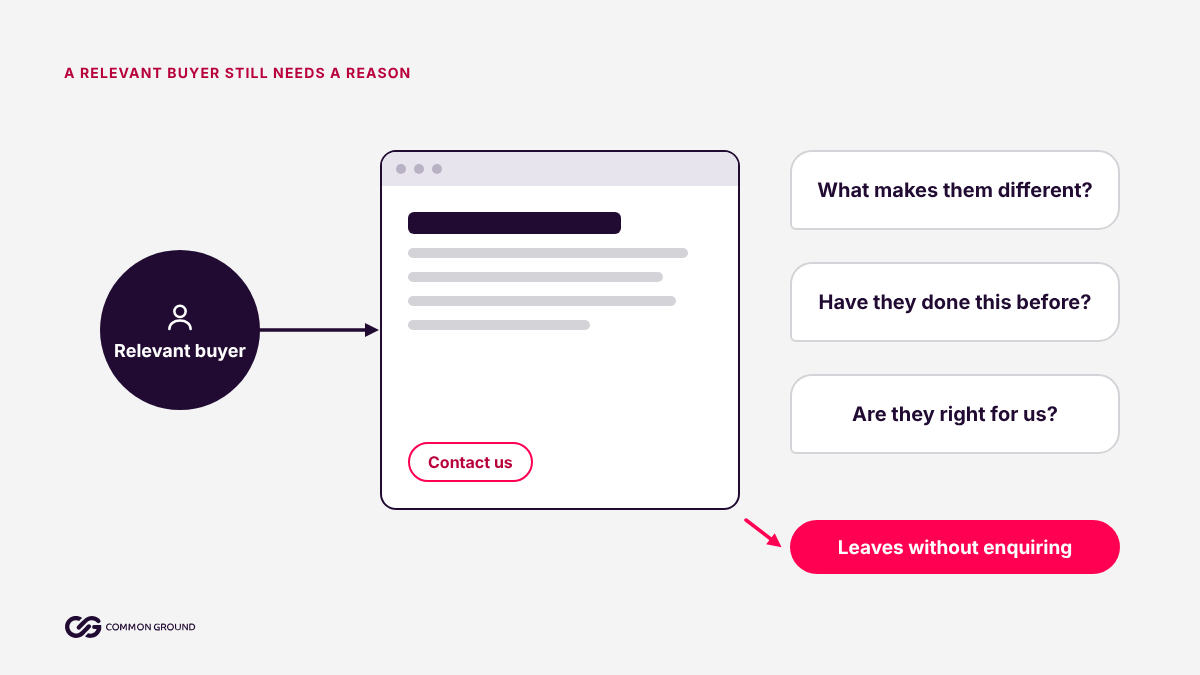
In those situations, more visibility doesn’t automatically create more confidence.
I think this is an important distinction when evaluating Search and Paid performance.
Those channels can help the business reach buyers with relevant needs.
They cannot, by themselves, resolve an unclear commercial proposition.
If the website doesn’t communicate the business’s expertise, suitability and value convincingly, acquisition investment may be doing its job while the wider buying experience falls short.
That doesn’t mean every conversion problem requires a major website or positioning project.
Sometimes the issue is much more specific.
A service page may not explain the types of organisations the business is best suited to support.
A commercially important claim may lack supporting evidence.
Or the information a buyer needs to assess suitability may be difficult to find.
The priority is to identify the particular uncertainty preventing progression, rather than assume that all visitors simply need stronger calls to action.
What you will learn in this post
What would +608% ROI look like for your brand?
That’s just one result. We’ve helped B2B brands across sectors scale SEO into real revenue, not just rankings. Want to see what’s possible?
Buyers need evidence before they’re ready to enquire
In complex B2B purchases, an enquiry can represent a meaningful commitment.
The buyer may need to justify the decision internally, involve other stakeholders or establish confidence that a supplier understands their commercial requirements.
That creates a gap between recognising a potential solution and being ready to speak to someone about it.
Marketing needs to support that evaluation process.
The relevant evidence will depend on the business, but it may include detailed explanations of its approach, relevant case studies, examples of the problems it solves or clarity about the types of clients it works with.
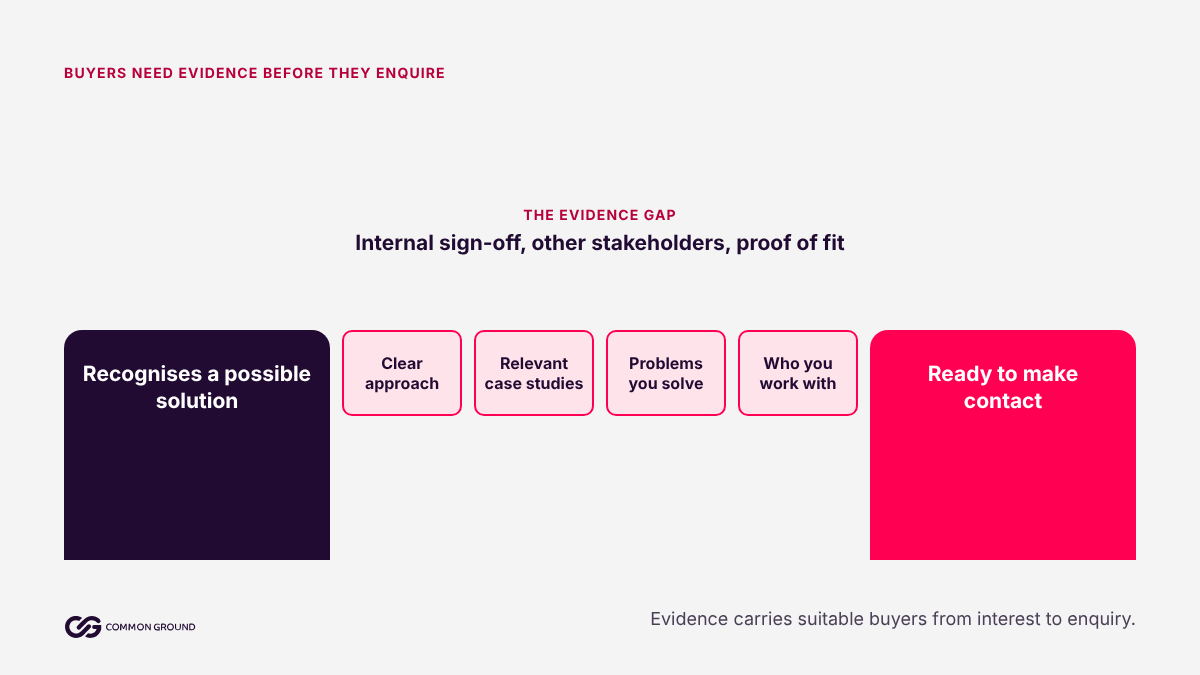
The point isn’t to publish more material for its own sake.
It’s to answer the questions that genuinely influence whether a suitable buyer is prepared to progress.
This is where I think some acquisition strategies become too focused on the initial conversion.
They concentrate on attracting visitors and encouraging enquiries without giving equal consideration to the information buyers need before they’re ready to make contact.
For an established marketing leader, the useful question isn’t simply whether the website has enough content.
It’s whether the business provides convincing evidence at the points where buyers are deciding if it belongs on their shortlist.
A buyer who doesn’t enquire isn’t necessarily the wrong buyer. They may not yet have enough confidence to take the next step.
The constraint may appear after the enquiry
Not every progression problem happens on the website.
Sometimes the business is generating enquiries from suitable organisations, but those enquiries aren’t developing into qualified opportunities.
At that point, the distinction between acquisition and commercial progression becomes especially important.
The business may have different interpretations of what constitutes a qualified lead or a suitable opportunity.
There may be a delay between enquiry and follow-up.
Or the initial enquiry may reveal expectations that don’t match the services, budget or buying requirements of the business.
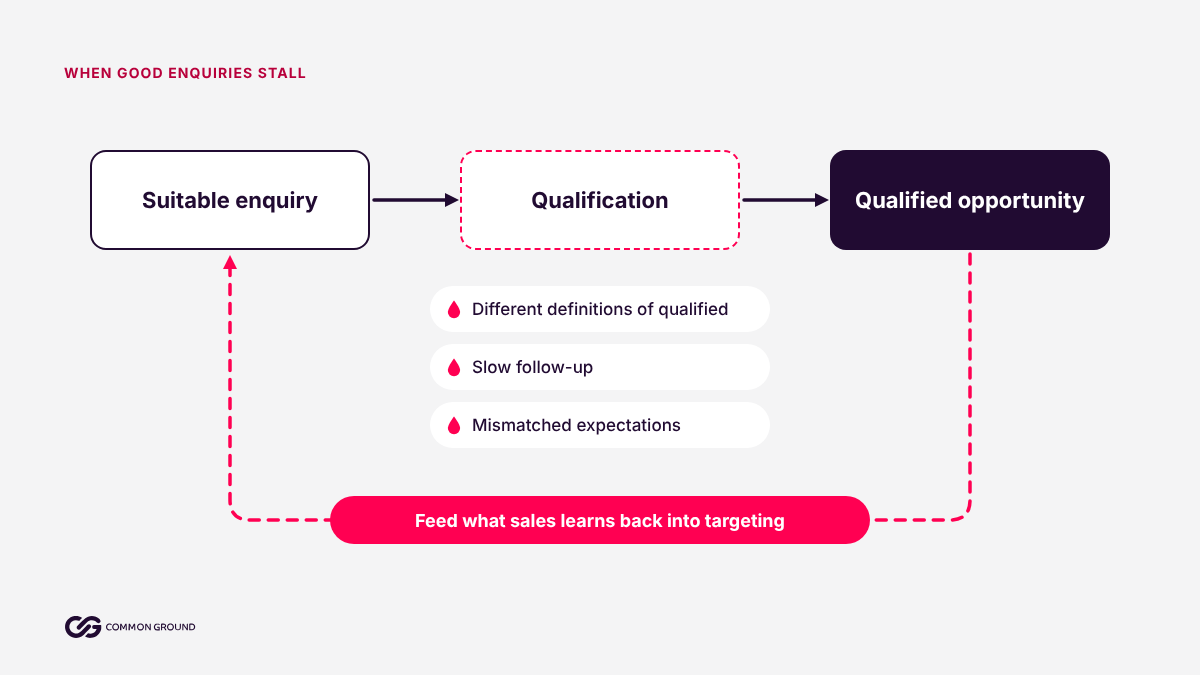
Some of these issues can be influenced by marketing. Others sit within the wider sales process.
As a Search, Paid and AI Growth Agency, our role isn’t to take ownership of a client’s entire commercial operation.
But we do need to understand what happens to the demand we’re helping generate.
Otherwise, there’s a risk of optimising acquisition around conversions that look successful in marketing reports but don’t contribute meaningfully to pipeline.
For example, if a particular campaign repeatedly generates enquiries that sales considers unsuitable, that information should influence targeting and messaging.
Equally, if suitable enquiries are being lost after contact, increasing the campaign budget may not be the most effective response.
The important thing is to distinguish the causes rather than treating every unsuccessful enquiry as evidence of poor acquisition.
Could your brand handle 60% more conversions?
That’s one result we delivered, but it’s far from the only one. From cutting wasted spend to scaling pipeline, our PPC strategies consistently drive performance for B2B brands.
More leads can make an existing weakness more expensive
There’s a commercial consequence to getting this diagnosis wrong.
If a business is losing suitable buyers because its proposition is unclear, additional traffic may increase the number of people encountering that same uncertainty.
If enquiries are failing to progress because qualification criteria are misaligned, more conversions may create additional work without generating proportionate pipeline.
And if acquisition targeting is genuinely poor, improving the website alone won’t resolve the underlying demand quality problem.
Each situation requires a different response.
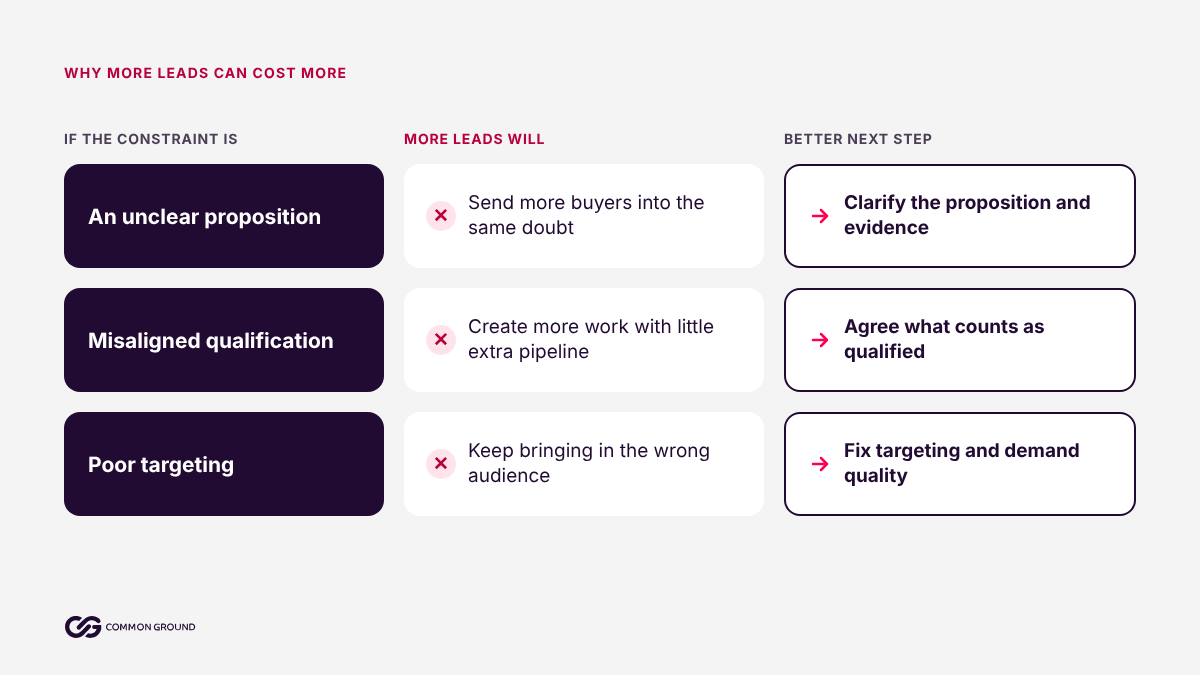
That’s why I prefer to look at the relationship between audience quality, website progression and qualified opportunities before recommending an increase in acquisition investment.
The aim isn’t to make every stage of the buying journey perfect before investing in growth.
There will always be some friction, and not every suitable buyer will convert.
The question is whether the business understands its most significant constraint well enough to invest in the right improvement.
Sometimes that will mean increasing Search or Paid activity.
Sometimes it will mean improving the information and evidence available to buyers.
And sometimes it will mean addressing how enquiries are qualified and progressed.
The best next investment depends on where the commercial opportunity is being lost.
Fix the constraint before increasing the volume
When a B2B business needs more qualified pipeline, generating additional demand is often part of the answer.
But it shouldn’t be the automatic answer.
A business that isn’t attracting enough suitable buyers has an acquisition problem.
A business that attracts suitable buyers but struggles to convert their interest may have an evaluation or conversion problem.
And a business generating suitable enquiries that don’t become opportunities may need to examine what happens after contact.
Those distinctions matter because the same headline symptom can lead to very different investment decisions.
For me, the starting point is understanding how much suitable demand the business is already capturing and where that demand stops progressing.
Only then can we make a sensible judgement about whether more acquisition activity is likely to produce more qualified pipeline.
More leads are valuable when they address the actual constraint. When they don’t, they can simply make an inefficient buying journey more expensive.
Are suitable leads failing to become qualified opportunities?
If you’re attracting relevant demand but not seeing enough progression into pipeline, we can help assess whether the constraint sits in acquisition or the wider buying journey.
Like what you’re reading? Get it in your inbox.
Join hundreds of B2B marketers getting practical SEO, PPC, and content insights. No fluff, no spam, just smart thinking that drives results.