

When a B2B marketing leader asks how their business can generate more qualified pipeline, much of the discussion naturally focuses on the channels they can measure.
Where does the business rank in Google? Which Paid campaigns generate opportunities? What converts on the website?
Those are important questions. But they don’t necessarily tell us where a potential buyer first encountered the business, what influenced their perception of it or why they decided to include it in their consideration.
That distinction has always mattered in B2B.
Buying decisions rarely begin and end with a single search. They involve research, internal discussions, recommendations and comparisons that marketing reporting can only partially capture.
What’s changing is the range of places where that research can happen.
AI-assisted search and research tools are becoming another way for buyers to explore problems, understand possible approaches and investigate potential suppliers.
For B2B marketing teams, this raises a practical question.
If the business is measuring where enquiries arrive, does it also understand where supplier consideration begins?
Key Takeaways:
- Consideration often starts before the enquiry. Attribution shows the last step, but buyers usually found the business earlier.
- The easiest channel to measure can get too much credit. The activity that puts the business on the shortlist is often harder to see.
- AI research matters more in some markets than others. How much depends on the industry, how complex the purchase is and how well buyers know the suppliers.
- A mention is only the first step. Visibility counts when it helps the right buyers see why the business is relevant.
- Start with how your buyers research. Then decide the role of Search, Paid and AI Visibility.
Discovery and conversion are different parts of the buying journey
A business may attribute an enquiry to organic search because the buyer visited its website from Google shortly before making contact.
That attribution can be useful. It tells us something about the interaction that led to the enquiry.
But it doesn’t necessarily explain how the buyer became aware of the business or what made them consider it credible.
They may have encountered the company through industry content, a recommendation, previous research or several earlier searches.
They may also have compared different approaches before deciding which suppliers were worth contacting.
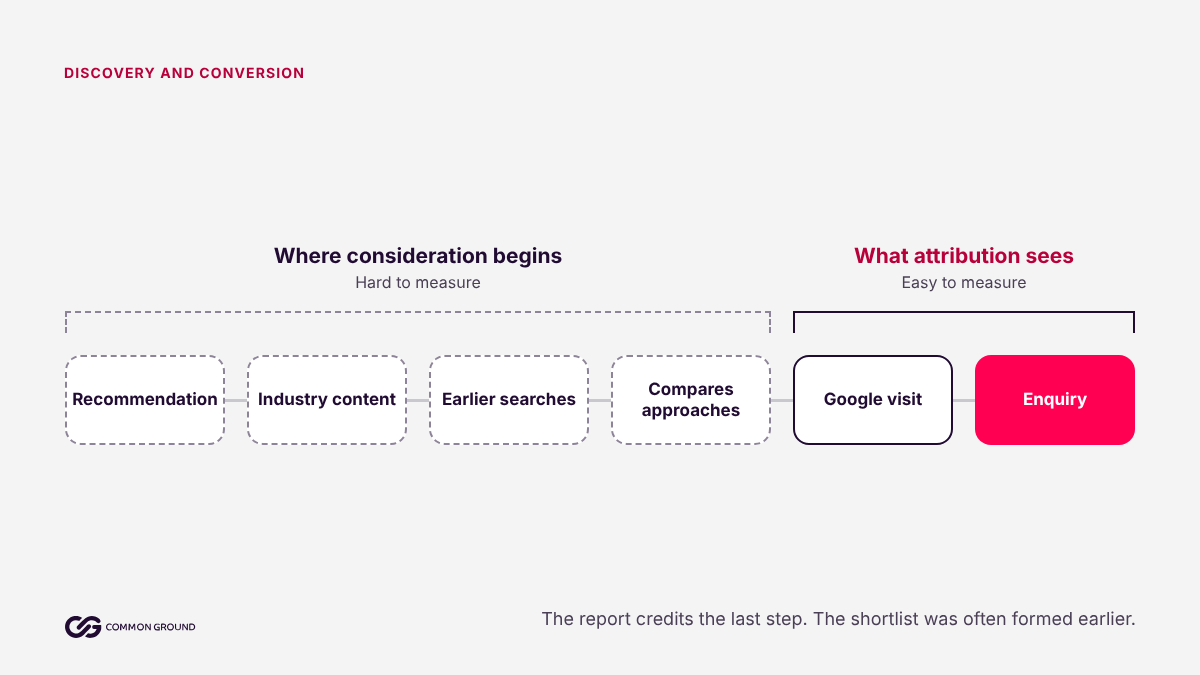
This isn’t a new problem created by AI. It’s a longstanding limitation of interpreting B2B buying behaviour through acquisition reports alone.
The commercial risk comes when marketing decisions are based too heavily on the interactions that are easiest to measure.
A channel may receive credit for capturing an enquiry without being responsible for creating the initial consideration.
Equally, activity that influences research and evaluation may appear less valuable because its contribution is harder to attribute directly.
That doesn’t mean attribution reporting should be disregarded.
It means we need to be clear about what it can and cannot tell us.
Understanding where an enquiry came from isn’t always the same as understanding why that supplier made the shortlist.
AI is changing how some buyers conduct research
AI-assisted research introduces another dimension to this challenge.
A buyer can now use generative tools to explore a problem, compare possible solutions or ask questions about the characteristics of different suppliers.
Instead of reviewing a series of search results individually, they may receive a synthesised response drawing on multiple sources.
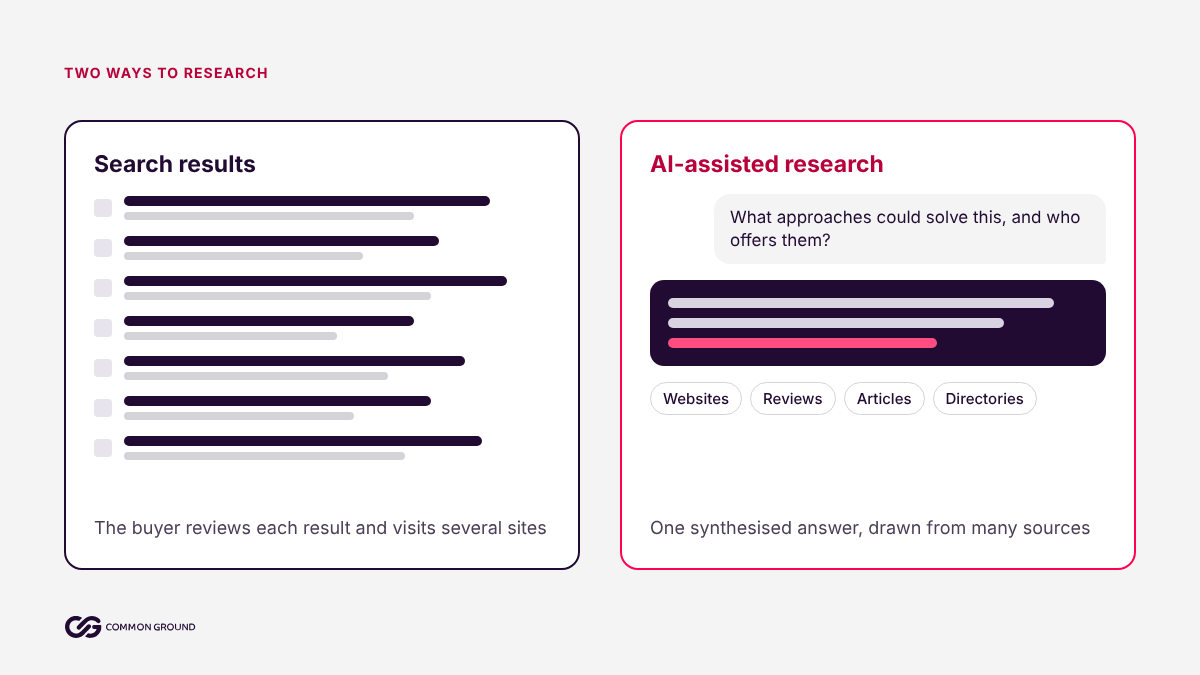
That creates a different discovery experience.
For some businesses, it may influence which approaches buyers investigate and which suppliers they encounter during early research.
But I think it’s important to avoid overstating what this means.
AI-assisted discovery won’t have the same significance in every B2B market. Buyer behaviour varies considerably depending on the industry, complexity of the purchase and familiarity with potential suppliers.
Traditional search remains important. So do recommendations, existing relationships, industry reputation and direct supplier research.
Nor should visibility within an AI-generated response be confused with commercial impact.
Being mentioned is not the same as being considered.
Being considered is not the same as generating a qualified opportunity.
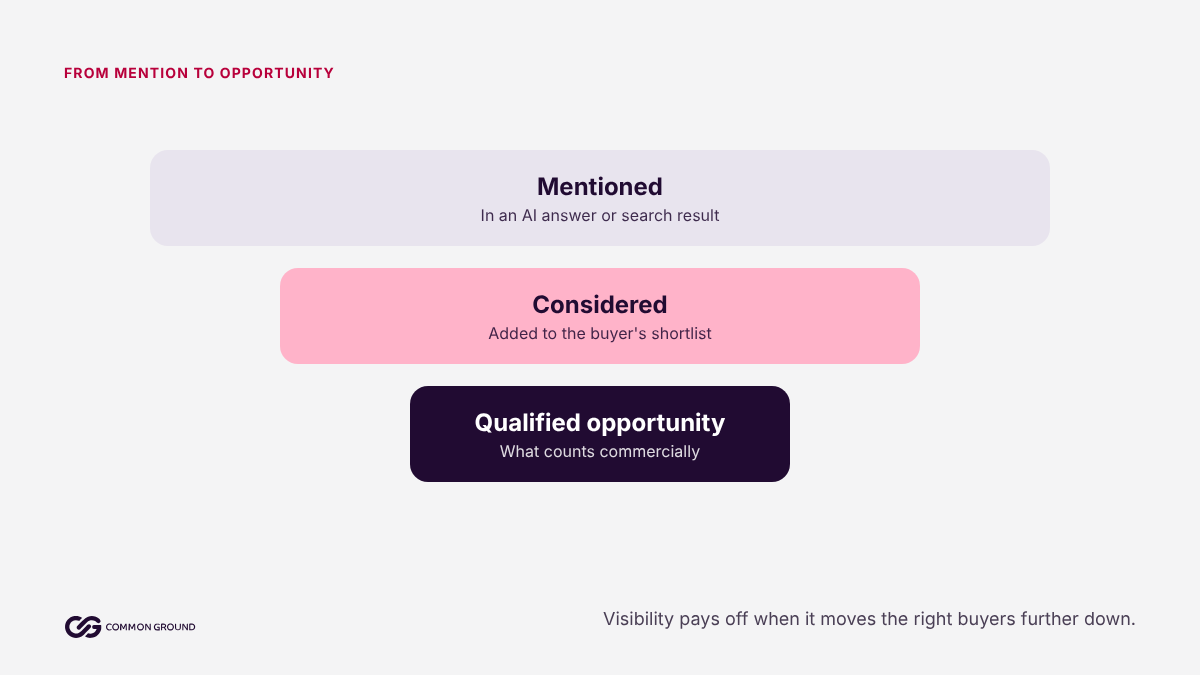
The question for marketing leaders isn’t whether they should pursue AI Visibility because the technology is growing.
It’s whether AI-assisted research is becoming relevant to how their particular buyers investigate problems and evaluate suppliers.
If it is, the business needs to understand what information those buyers are likely to encounter and how accurately the business is represented.
What you will learn in this post
What would +608% ROI look like for your brand?
That’s just one result. We’ve helped B2B brands across sectors scale SEO into real revenue, not just rankings. Want to see what’s possible?
The information buyers encounter matters as much as the channel
One implication of changing discovery behaviour is that businesses need to think beyond their position in a particular set of search results.
When a potential buyer researches a supplier, they’re trying to establish whether that business is relevant, credible and capable of addressing their requirements.
They may want to understand its specialisms, experience, approach and suitability for a particular type of organisation.
That information needs to be clear wherever the buyer encounters it.
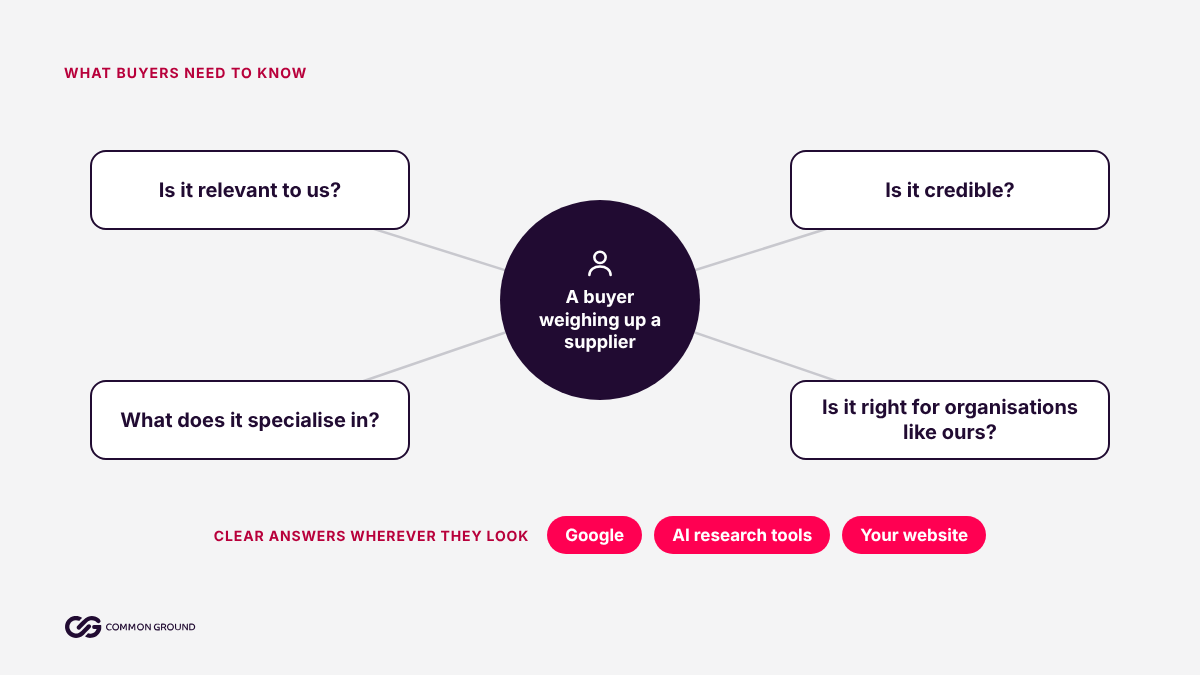
A business with an ambiguous proposition or limited evidence of its expertise can struggle to communicate its value, regardless of whether the interaction happens through Google, an AI-assisted research tool or a direct website visit.
This is one reason I don’t see AI Visibility as a replacement for Search.
Strong Search foundations still matter.
Clear service information, accessible content, relevant expertise and credible supporting evidence help buyers understand a business. They also provide useful information that discovery systems may draw upon.
But the objective shouldn’t be to produce more content simply to appear in more places.
It should be to make the business easier for suitable buyers to discover, understand and evaluate.
Visibility only becomes commercially useful when it helps the right buyers recognise why a business is relevant to them.
What should B2B marketing leaders do differently?
I wouldn’t recommend responding to changing discovery behaviour by immediately adding another disconnected activity to the marketing plan.
The starting point should be the buyer.
How do suitable organisations typically begin researching the problems the business solves?
Which searches and sources are most relevant when they move from understanding a problem to evaluating suppliers?
What information do they need before they’re confident enough to make contact?
And is there evidence that AI-assisted research is becoming part of that process?
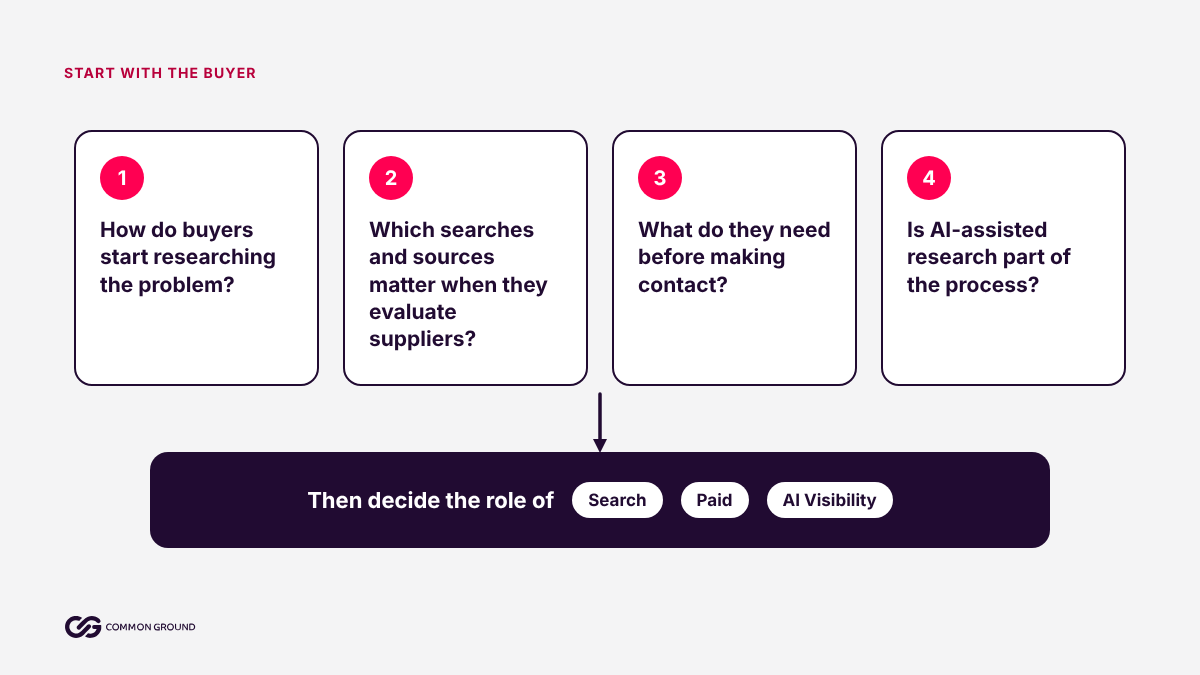
Those questions can help determine where Search, Paid and AI Visibility should contribute.
Search may remain the primary way to capture established commercial demand.
Paid may be valuable for reaching particular audiences or strengthening visibility around priority opportunities.
AI Visibility may become increasingly relevant where buyers use generative tools to research solutions and suppliers.
The appropriate balance won’t be identical for every business.
It’s also important to be realistic about measurement.
Search rankings, Paid conversions, AI mentions and referral traffic provide different kinds of evidence. None should automatically be treated as a complete measure of influence on qualified pipeline.
Marketing leaders need to combine channel performance with what they know about buyer behaviour, enquiry quality and commercial progression.
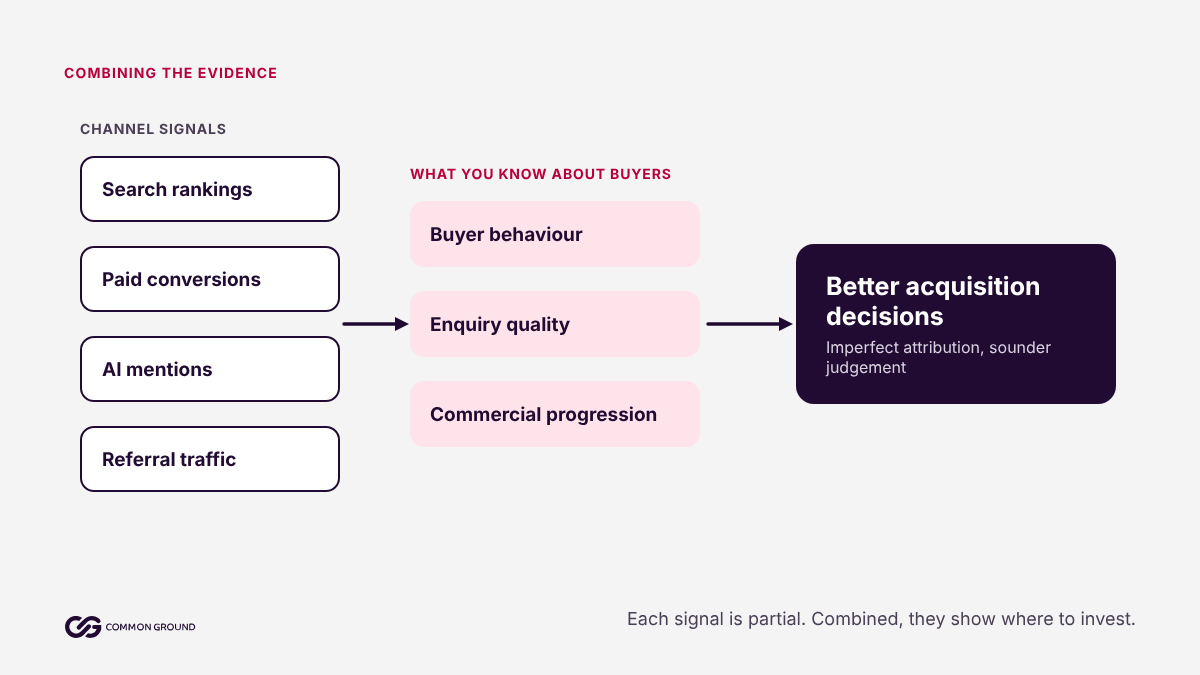
That won’t produce perfect attribution.
But it can support better decisions than assuming the most measurable interaction was necessarily the most influential one.
Could your brand handle 60% more conversions?
That’s one result we delivered, but it’s far from the only one. From cutting wasted spend to scaling pipeline, our PPC strategies consistently drive performance for B2B brands.
The objective hasn’t changed
B2B buyers have always used more information than marketing reporting can fully account for.
AI-assisted research is adding to that complexity, but it hasn’t changed the fundamental commercial objective.
Businesses still need to be discovered by suitable buyers, establish credibility during evaluation and generate qualified opportunities.
The challenge is ensuring that acquisition strategy reflects how those buyers actually research and make decisions.
For some businesses, that will mean strengthening existing Search activity.
For others, it may mean reassessing the relationship between Search, Paid and AI Visibility.
The right response should be guided by commercial relevance, not the pressure to adopt another channel.
The opportunity isn’t simply to become visible in more places. It’s to become more discoverable and credible at the moments that influence supplier consideration.
Is your acquisition strategy keeping pace with buyer discovery?
If you’re unsure whether Search, Paid and AI Visibility reflect how your buyers research and evaluate suppliers, we can help assess where the most relevant opportunities sit.
Like what you’re reading? Get it in your inbox.
Join hundreds of B2B marketers getting practical SEO, PPC, and content insights. No fluff, no spam, just smart thinking that drives results.