

When a B2B business tells me its Paid acquisition costs are increasing, my first instinct isn’t necessarily to question how well the campaigns are being managed.
There may be opportunities to improve targeting, messaging or conversion performance. But sometimes the campaigns are already doing a reasonable job.
The more interesting question is whether the business has reached a point where increasing its Paid investment is no longer producing a proportionate increase in qualified pipeline.
It’s an important distinction.
A campaign can remain profitable while becoming progressively harder to scale. Cost per click may rise, the available audience may become more competitive, or additional budget may reach buyers with weaker commercial intent.
None of those outcomes automatically means Paid is failing.
They may simply indicate that the business is approaching the limits of what its current acquisition model can deliver.
The problem isn’t always Paid performance. Sometimes it’s the assumption that more Paid investment will continue producing more growth at the same rate.
Key Takeaways:
- Rising Paid costs can mean you’re reaching a limit. Well-run campaigns can still become harder to scale as competition rises and additional budget reaches buyers with weaker intent.
- Paid easily becomes the default growth lever. Because it’s the quickest part of the mix to adjust, it tends to absorb every new pipeline target, and the business can end up dependent on it without ever deciding to.
- Budget can capture demand but can’t create it. B2B audiences are often small, so each extra pound in high-intent campaigns tends to produce fewer new opportunities than the last.
- Average results can hide weakening returns. Look at the marginal return on the next increase in spend as well as overall cost per opportunity.
- Heavy Paid investment is fine when it’s a considered choice. The risk lies in depending on Paid with little organic presence or understanding of the alternatives.
Why Paid becomes the default growth lever
Paid is attractive because it offers a degree of control that other acquisition activities don’t.
Businesses can adjust budgets, target particular audiences, respond to commercial priorities and generate visibility without waiting for organic positions to develop.
For a B2B marketing leader under pressure to contribute to pipeline, those characteristics are valuable.
If a campaign is generating suitable opportunities, increasing the budget can seem like a logical next step.
And often it is.
The challenge emerges when Paid becomes the default response to every requirement for additional pipeline.
A quarterly target increases, so budgets rise. A new commercial priority appears, so another campaign launches. Organic acquisition isn’t growing quickly enough, so Paid is expected to make up the difference.
Over time, the business can become increasingly dependent on one mechanism for generating its next opportunity.
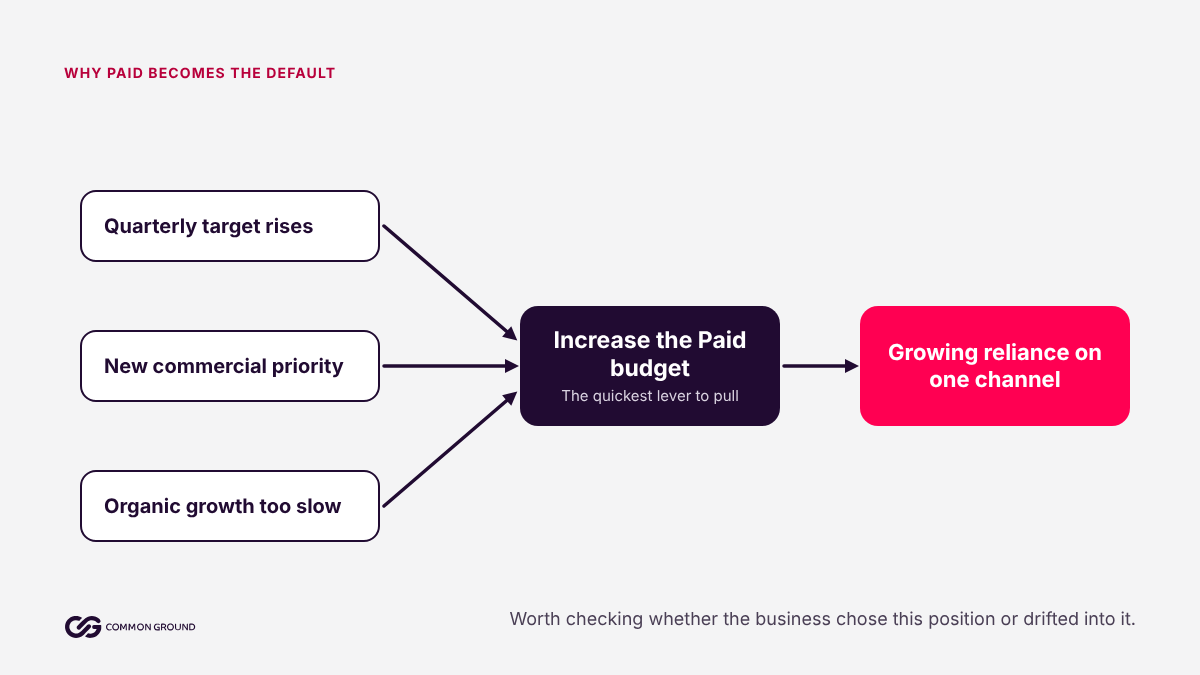
That dependency may be perfectly reasonable if the economics remain attractive and the market offers sufficient demand.
But it’s worth understanding whether the business is deliberately choosing that position or has arrived there because Paid is the most immediately adjustable part of its acquisition strategy.
More budget doesn’t create more demand
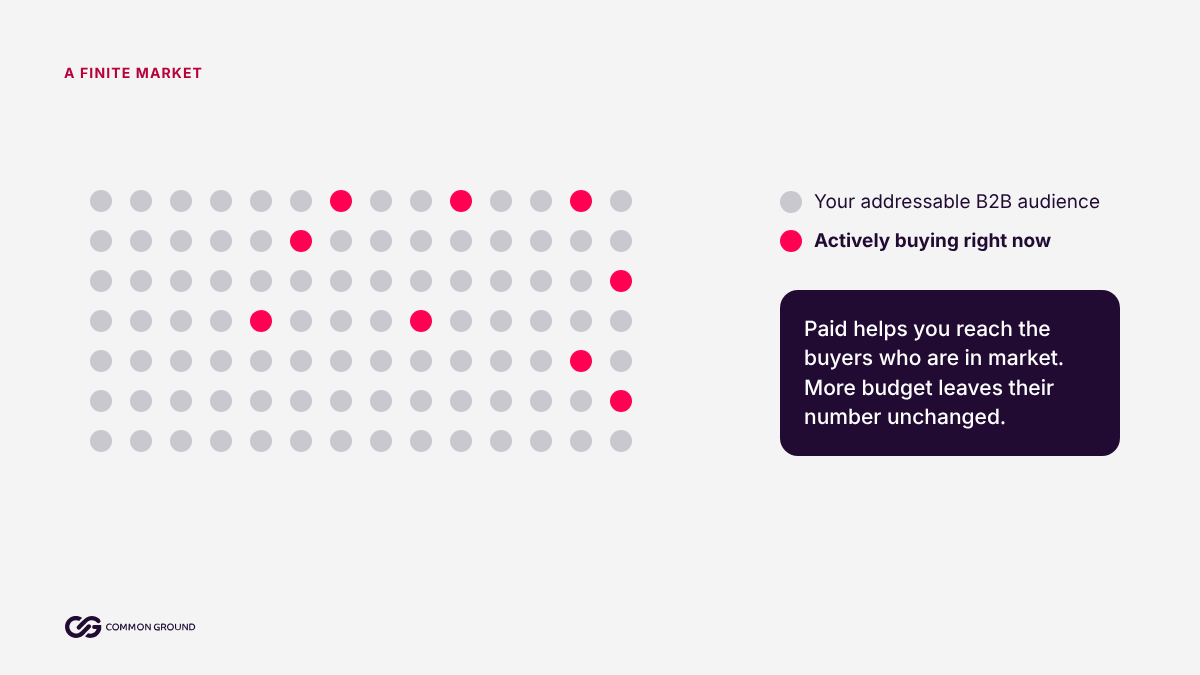
One of the limitations of scaling Paid in B2B is that the commercially relevant audience is often relatively small.
A business may serve a defined set of industries, company sizes or buying groups. The number of organisations actively considering a relevant purchase at any given time is limited.
Paid can help the business reach those organisations.
It cannot automatically increase the number of suitable buyers currently in the market.
This matters particularly in high-intent search campaigns.
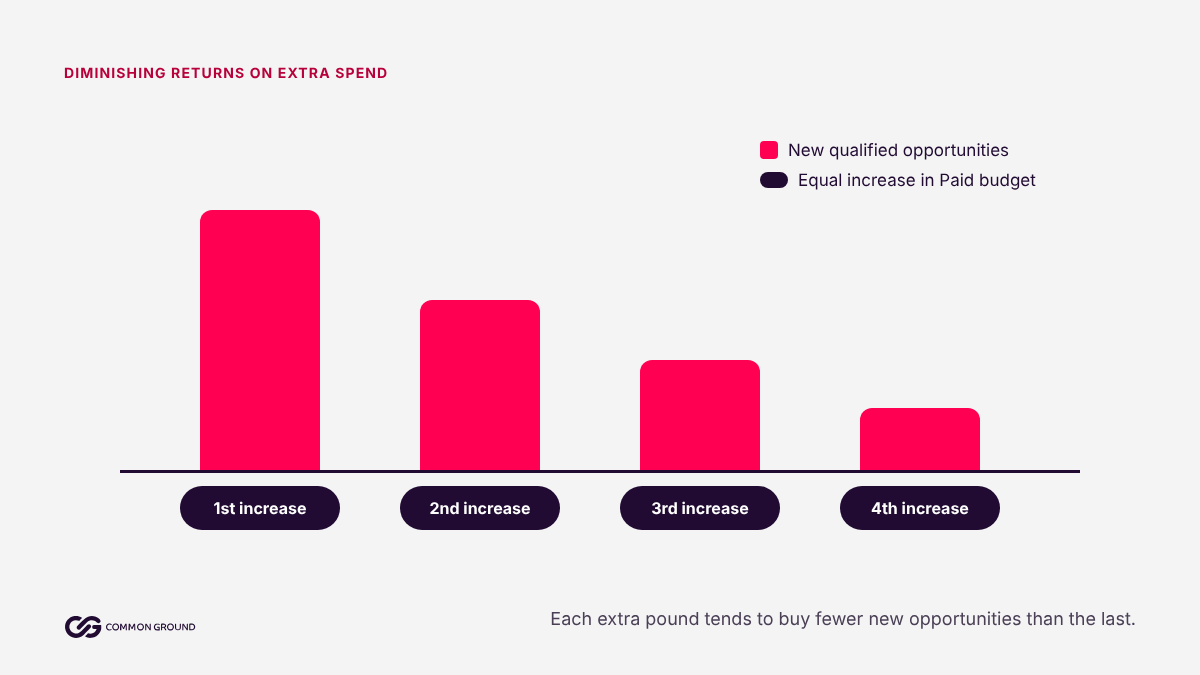
The initial budget may capture a valuable proportion of relevant searches. Increasing investment can then improve coverage, but eventually the additional opportunities become harder to find.
The next increment of spend may generate fewer incremental opportunities than the previous one.
Alternatively, the business may need to expand into broader search terms, different audiences or earlier stages of consideration.
That can be commercially sensible, but the economics and expected timescale may change.
It’s not reasonable to expect every additional pound to perform like the first.
The question is whether the next increase in Paid investment is likely to produce enough additional qualified pipeline to justify its cost.
That’s a different decision from asking whether existing campaigns are meeting their targets.
What you will learn in this post
What would +608% ROI look like for your brand?
That’s just one result. We’ve helped B2B brands across sectors scale SEO into real revenue, not just rankings. Want to see what’s possible?
Average performance can conceal the cost of growth
When evaluating Paid, it’s natural to look at overall performance.
How much was spent? How many qualified opportunities were generated? What was the acquisition cost?
Those figures matter, but they don’t always tell us what happens when the business tries to scale.
Imagine a campaign that has historically generated qualified opportunities at an acceptable cost.
The marketing team increases investment and total opportunity volume rises.
At first glance, that’s a positive result.
But if the additional spend is producing proportionately fewer opportunities, the economics of that growth may be less attractive than the overall figures suggest.
The existing campaign performance can make the average look healthy even as the return on incremental investment weakens.
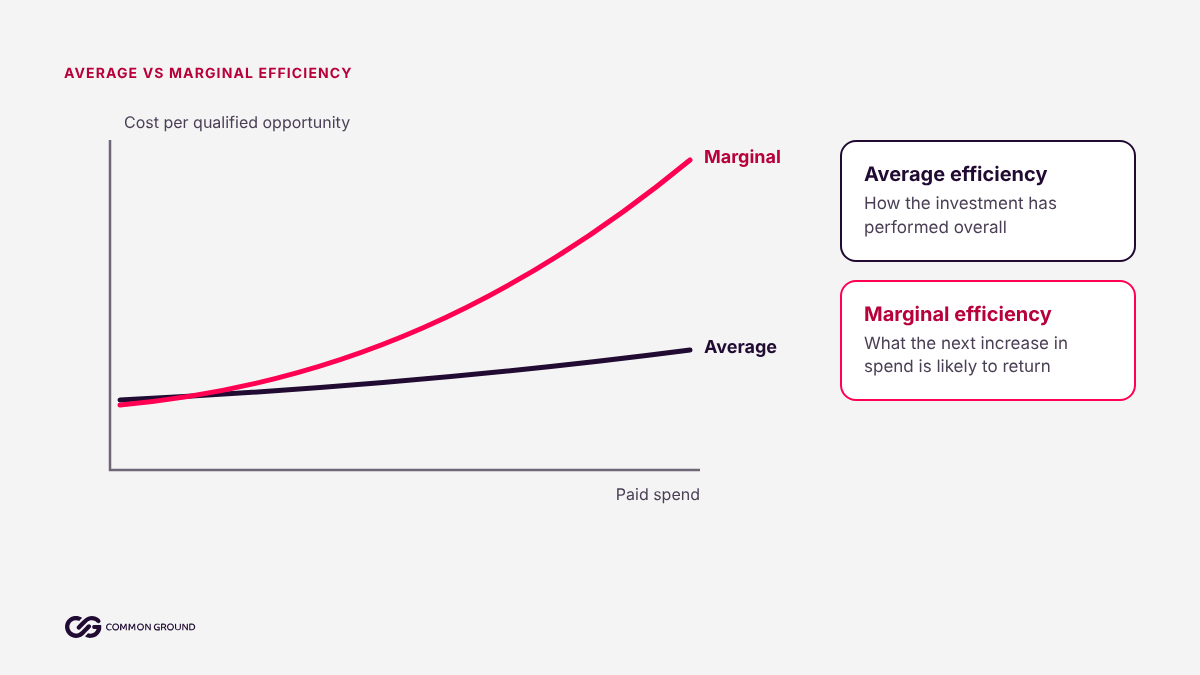
That’s why I think the distinction between average acquisition efficiency and marginal acquisition efficiency deserves more attention in B2B Paid discussions.
The former tells us how the investment has performed overall.
The latter helps us assess whether putting more money into the same approach is the best next commercial decision.
In practice, that assessment isn’t always straightforward. Sales cycles can be long, attribution is imperfect and opportunity values vary.
But those limitations don’t make the question less important.
They mean we need to assess incremental performance carefully rather than assuming that a historically successful campaign will scale indefinitely.
Dependency becomes a problem when the business has limited alternatives
I don’t think a business should aim to reduce its reliance on Paid simply for the sake of having a more balanced channel mix.
Some B2B markets are highly competitive organically. Others have commercial priorities that make Paid particularly valuable.
A substantial Paid investment can be entirely justified.
The risk is greater when the business depends heavily on Paid but has little understanding of what would happen if its acquisition economics deteriorated.
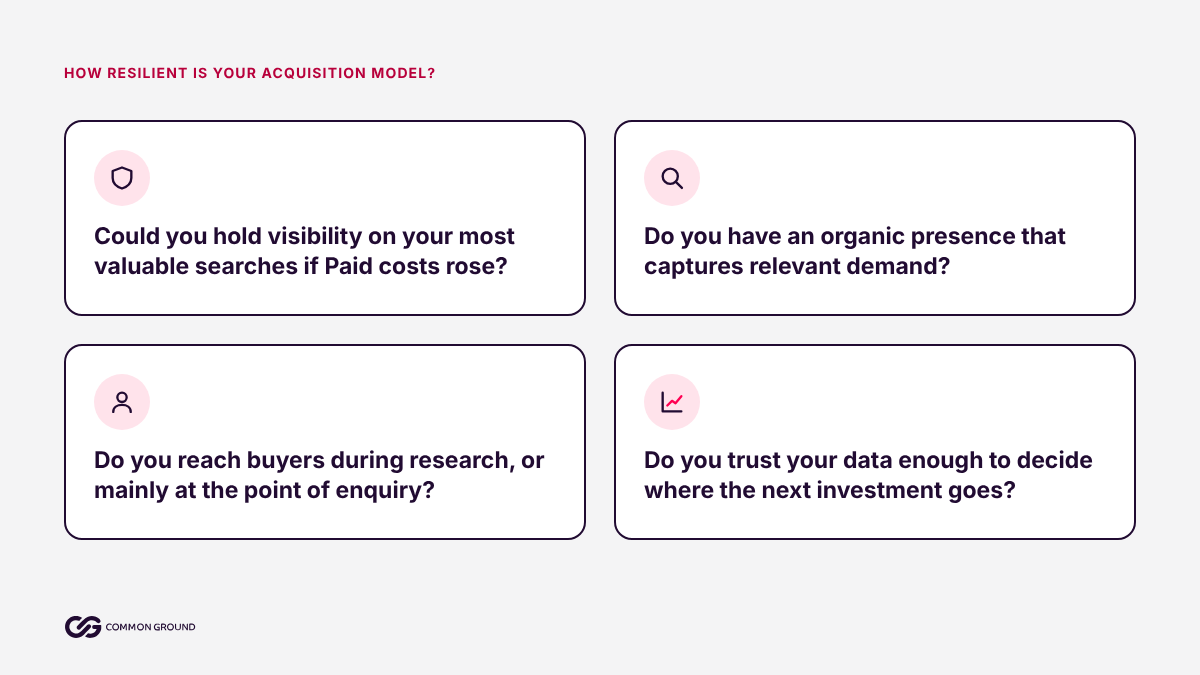
Could it maintain visibility around its most valuable commercial searches?
Does it have an organic presence capable of capturing relevant demand?
Is it reaching suitable buyers during the research and evaluation process, or mainly when they are ready to make an enquiry?
And does the business have enough confidence in its acquisition data to decide where additional investment should go?
These aren’t arguments for spreading budget across channels indiscriminately.
They’re questions about the resilience of the acquisition model.
If Paid remains the strongest commercial option, the right decision may be to continue investing in it.
But that should follow from an assessment of the alternatives, not from the absence of them.
Could your brand handle 60% more conversions?
That’s one result we delivered, but it’s far from the only one. From cutting wasted spend to scaling pipeline, our PPC strategies consistently drive performance for B2B brands.
What should happen when Paid growth becomes harder?
When additional Paid investment starts producing diminishing returns, I think there are three areas worth examining.
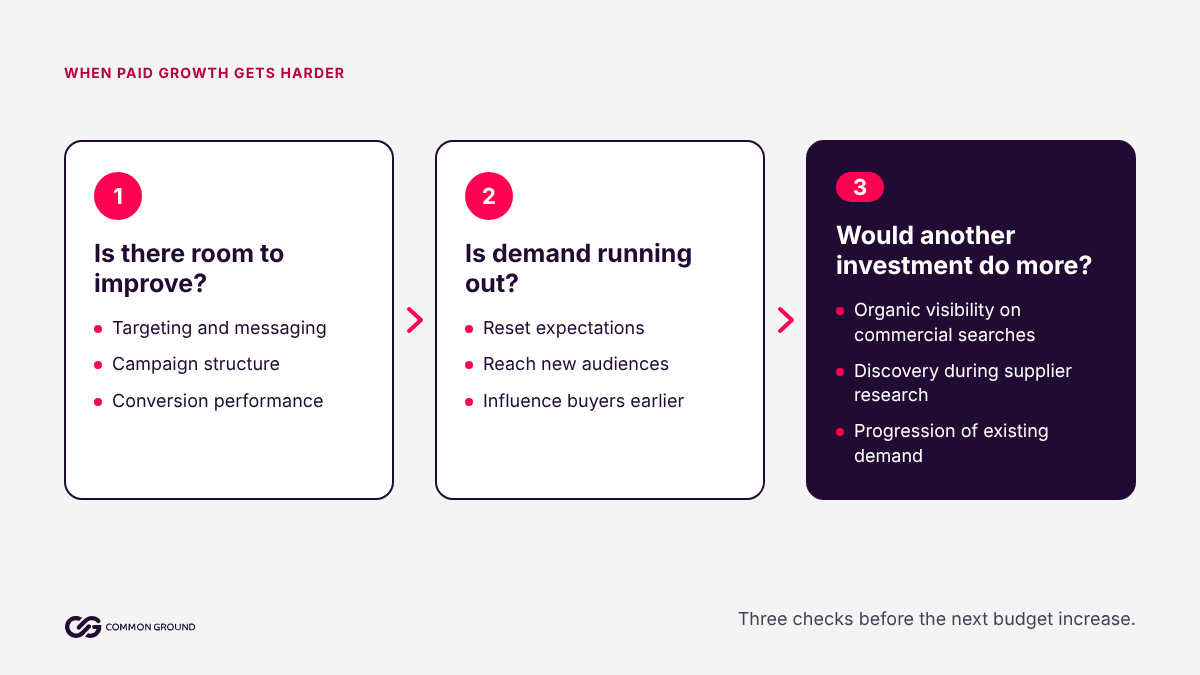
The first is whether there is still meaningful room to improve the existing activity.
Targeting, messaging, campaign structure and conversion performance may offer opportunities to capture more value without simply increasing spend.
The second is whether the business is trying to extract more demand than is realistically available within its current market and targeting.
If so, expectations need to change. Reaching new audiences or influencing buyers earlier may require a different approach and a longer view of performance.
The third is whether another acquisition investment could make a stronger contribution to future pipeline.
That might involve strengthening organic visibility around commercially relevant searches, improving how the business is discovered during supplier research, or addressing weaknesses that limit the progression of existing demand.
The answer depends on the business.
What matters is resisting the assumption that every pipeline shortfall should be addressed by adding more budget to the channel that is easiest to scale operationally.
The goal isn’t to spend less on Paid
Paid is an important part of B2B acquisition, and for many businesses it should remain a significant investment.
The objective isn’t to minimise that investment or replace it with organic activity.
It’s to understand where Paid creates the most commercial value, how far it can realistically scale and when another approach might produce a better return.
A business can have effective campaigns and still be too dependent on them for its next stage of growth.
Equally, a business can spend heavily on Paid without having a dependency problem, provided the investment remains commercially justified.
The distinction is whether Paid investment is being guided by the economics of qualified pipeline growth or simply increased whenever the business needs more opportunities.
That’s the conversation worth having before the next budget increase.
Is your Paid investment becoming harder to scale?
If increasing spend isn’t producing the qualified pipeline growth you expect, we can help assess whether the constraint sits within your campaigns or the wider acquisition strategy.
Like what you’re reading? Get it in your inbox.
Join hundreds of B2B marketers getting practical SEO, PPC, and content insights. No fluff, no spam, just smart thinking that drives results.