
What you will learn in this post
Artificial Intelligence (AI) is flooding the marketing world. Some love it, some fear it, and most are in between.
For Business-to-Business (B2B) marketers, AI is no longer a futuristic concept, it’s already reshaping the landscape of B2B content marketing.
CMO’s are grappling with questions like: Is AI a threat or an opportunity? How can it fit into our content strategy? And most importantly, how do we maintain our brand’s voice and authenticity in an AI-driven world?
At Common Ground, we understand these concerns. In this guide, we’ll separate hype from reality, highlight where AI adds value (and where it doesn’t), and show you how to future-proof your content strategy.
Let’s delve into how AI content influences B2B marketing and what you, as a strategic leader, need to consider.
Artificial Intelligence in B2B Content Marketing
AI tools like Chatgpt, Jasper, Claude, and Gemini have moved from novelty to necessity almost overnight. What started as a playground for early adopters is now a serious talking point in boardrooms. Content teams are under pressure to scale, and automation offers an enticing shortcut.
AI is reshaping B2B content marketing by helping teams scale personalised, data-driven content without ballooning costs. Unlike B2C, B2B marketing often involves longer sales cycles, complex buyer journeys, and niche audiences – all of which demand tailored, high-value content across multiple touchpoints.
AI supports marketers by automating research, speeding up production, and generating insights to refine messaging, freeing up teams to focus on strategy, creativity, and relationship-building.
It’s no surprise that marketers are intrigued. Generative AI promises faster, cheaper content creation. But without a clear plan, it can quickly devolve into low-value fluff.
What B2B Content Teams Are Using AI For
B2B marketers are leveraging AI in various ways, not to replace human creativity, but to streamline processes and support content at scale. Used wisely, these tools can boost efficiency without compromising strategy.

AI Use Cases in B2B Content Production
- Ideation and Research: AI tools can rapidly surface trending topics, customer pain points, and keyword opportunities, helping content teams quickly validate ideas and shape editorial calendars. This cuts down the time spent trawling through Google or forums and makes it easier to stay aligned with audience interests.
- Drafting Outlines or First Passes: Many teams use AI to produce rough blog structures, introductory paragraphs, or even full first drafts. While these outputs typically need heavy editing, they’re a helpful head start, especially when deadlines are tight or team resources are stretched.
- Repurposing Content Across Formats: AI excels at turning long-form assets like webinars or whitepapers into bite-sized content for social, email, or landing pages. This kind of content recycling helps teams get more mileage from their big-ticket assets without burning out.
- Translation/Localisation: AI-powered translation tools offer a quick and cost-effective way to make content accessible in multiple languages. While human localisation is still essential for cultural nuance, AI can handle the heavy lifting and speed up production timelines.
- SEO Enhancements: From suggesting keywords to writing meta descriptions and headers, AI is increasingly part of SEO workflows. Some tools even offer content scoring based on Google’s ranking factors, making it easier to optimise pages before they go live.
By using AI in these areas, marketers can spend more time on high-value work that machines can’t replicate: strategy, creativity, and connection.
The Pros and Cons of Using AI in B2B Marketing
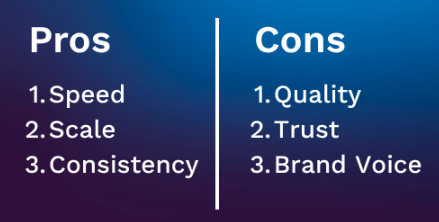
The Benefits: Speed, Scale, and Consistency
AI offers significant advantages for B2B marketers under pressure to do more with less. One of the most obvious benefits is speed. AI tools can generate content in seconds, not hours.
That speed translates into scale, enabling small or lean teams to deliver across more formats and channels than they might otherwise manage. Whether it’s a blog post, email copy, or social media caption, AI can provide a solid first draft or support faster production of assets that typically take hours to craft.
Then there’s consistency. AI tools excel at maintaining tone, structure, and formatting across large volumes of content. For brands operating across multiple markets or managing several products, this can be a real advantage, especially when producing repetitive formats like product descriptions or meta tags.
Used well, AI enables marketers to streamline workflows, increase output, and deliver at scale, without compromising on quality.
The Risks: Quality, Trust, and Brand Voice
But AI isn’t a silver bullet. While fast, scalable content is appealing, the trade-offs matter.
One of the biggest challenges is quality. Because generative AI pulls from a vast pool of online content, the tone can often feel templated, robotic, or worse… generic. For B2B brands striving to stand out, that lack of originality can dilute brand perception and undermine thought leadership efforts.
There’s also the issue of factual accuracy. AI tools can (and do) hallucinate. That means making up stats, misquoting sources, or referencing outdated information. Inaccuracy erodes trust, and in sectors like finance, tech, or healthcare, that can have real consequences.
Plagiarism is another ethical concern. AI-generated text can walk a fine line between “inspired by” and “lifted from.” While most tools aren’t designed to copy outright, they may replicate popular phrases or structures too closely for comfort, particularly when drawing from the same online data sets everyone else is using.
Finally, and perhaps most importantly for B2B content, is the lack of nuance. AI struggles with emotional intelligence, subtlety, and cultural context. It can’t read the room. It doesn’t know your audience’s internal politics, strategic priorities, or market dynamics.
For content to truly resonate, especially in long, complex buying journeys, human insight still matters.
Is Generative AI a Threat to Human Writers?
While it’s tempting to view AI as a looming threat to human writers, the reality is far more nuanced.
AI can mimic structure and language patterns with impressive speed, but it still lacks the intuition, emotional depth, and critical thinking that define truly impactful content.
AI is most effective when treated as a collaborative tool rather than a standalone solution. It’s excellent at accelerating first drafts, summarising research, or automating repetitive, low-stakes content, like meta descriptions or product blurbs. But it struggles with crafting a compelling narrative, using tone strategically, or responding to subtle shifts in audience needs.
Importantly, AI-generated content still requires human oversight. Writers and editors must guide the brief, ensure factual accuracy, refine the language, and inject the brand’s unique point of view. Without that layer of human quality control, the risk of tone-deaf, incorrect, or uninspiring content rises dramatically.
Far from replacing marketers, AI has the potential to elevate their role. By offloading routine tasks, it creates space for strategic thinking, creativity, and storytelling – the very things that set great content apart.
In short, think of AI as a smart assistant: powerful, useful, and efficient, but only as effective as the humans guiding it.
Best Practices for Using AI in Your B2B Content Strategy
To make AI work for your content strategy, the key is to maintain a strong human presence throughout the process.
AI should serve as a support system, handling repetitive or time-consuming tasks, while humans provide oversight, creative input, and final approval. Content should always be reviewed to ensure it reflects your brand’s tone, values, and voice.
It’s important to be selective in how you use AI. Reserve it for content types where speed and efficiency matter most. For your business, this could be producing social media captions, generating meta descriptions, or creating early content drafts.
For high-impact pieces, such as leadership articles or nuanced thought leadership, human input remains irreplaceable. The goal is not to automate everything, but to use AI where it genuinely adds value.
Three Top Tips for Using AI Content in B2B Marketing
1. Keep Humans in the Loop
Always:
- Edit and sense-check AI content
- Align output with your brand’s tone and goals
- Treat AI as the draft, not the destination
2. Use AI Where It Adds Real Value
The best use cases are:
- Repetitive tasks like social posts, SEO metadata, or FAQ content
- First drafts that spark ideas, not final products
- Structured formats like product descriptions or event summaries
Avoid using AI for:
- Deep thought leadership
- Sensitive or nuanced topics
- High-stakes brand communications
3. Protect Your Brand Voice in the Age of AI
As AI-generated content becomes more prevalent, maintaining a distinct and consistent brand voice becomes even more important. Regular audits of AI-generated content can help catch issues early and ensure that even at scale, your brand voice remains intact. Think of AI as a contributor to your content team that needs ongoing training and supervision.
- Develop clear editorial guidelines.
- Use AI tools trained on your content (if possible)
- Treat your voice as sacred; AI should reinforce, not overwrite it
AI and SEO: Friends or Foes?
AI tools can streamline SEO by rapidly identifying keywords, suggesting topic clusters, and even optimising metadata, but they also introduce risks.
Over-reliance on AI-generated content can lead to generic, thin copy that underperforms in rankings and damages credibility.
For CMO’s, the priority should be establishing clear SEO guidelines for content teams using AI. That includes investing in training to help teams evaluate AI outputs critically, setting quality benchmarks, and ensuring human review remains central to the SEO process.
Can AI Content Rank in Search?
Yes, but not all AI content is equal.
AI content can perform well in search engines, but only if it meets the same quality standards as human-created content. Search engines like Google now emphasise experience, expertise, authoritativeness, and trustworthiness (E-E-A-T). Content that simply checks boxes without offering real value to readers will struggle to rank.
Google doesn’t care who wrote it. What matters is:
- Relevance and intent
- Originality
- Expertise, Experience, Authoritativeness, and Trust (EEAT)
Human input is still crucial to meet these standards.
Google’s View on AI-Generated Content
Google has made it clear that the issue isn’t whether content is AI-generated, but whether it’s useful, original, and created with the user in mind.
If AI content fails to demonstrate genuine expertise or reads like a shallow summary, it could be penalised.
In other words, it’s not about the tool, it’s about the outcome.
The Future of B2B Content Creation: Human + AI
The most effective content teams in the future will be hybrid, blending the speed and consistency of AI with the strategic insight of human creators.
This means upskilling marketers to work effectively alongside AI tools, understanding how to prompt effectively, and how to interpret AI-generated suggestions critically. As AI evolves, so too will the roles and responsibilities within marketing teams.
Building a Hybrid Content Team
As AI becomes a permanent fixture in content creation, marketing leaders must rethink team structures. A modern hybrid content team blends in-house strategists and editors with AI tools and specialist freelancers, all working in concert.
Forward-thinking teams are combining:
- Strategic humans – who understand the brand, audience, and funnel
- AI tools – for ideation, scaling, and speed
Upskill your marketers to:
- Use prompt engineering effectively
- Spot and edit AI content weaknesses
- Build workflows where AI fits into the process
CMO’s should also factor in budget allocation – balancing spend across tech, talent, and training. Structuring the content function around clear processes (from ideation to distribution), well-defined roles, and smart AI integrations ensures scalability and consistent quality.
Tech to Watch: What’s Next in AI for Marketers?
Innovations are emerging quickly. AI tools are now capable of evaluating content performance and making data-informed improvement suggestions. Some are even experimenting with AI-generated video and predictive content personalisation based on user behaviour.
Tools that can dynamically adjust tone and style to suit different audiences are also on the horizon. Staying current with these developments will help CMO’s stay ahead.
Emerging AI capabilities include:
- Content scoring – Assessing quality, tone, or alignment with your style
- AI video – Script writing, editing, and even voiceovers
- Predictive personalisation – Using behaviour data to inform content
- Real-time editing – Tools that adapt tone or format on the fly
We’re just scratching the surface – once you dig into it, there is so much more. That’s something for a future blog.
How Common Ground Uses AI (and Where We Don’t)
At Common Ground, we see AI as a powerful partner in delivering efficient, high-quality content strategies. We use it to support areas like data analysis, content optimisation, and first-draft creation. These use cases help us save time while ensuring we still meet high creative standards.
Our Approach to AI Content for Clients
As mentioned, we use AI to work smarter, not lazier.
- We use AI for research, SEO support, and first-draft generation
- We rely on humans for strategic thinking, tone alignment, and quality control
- We treat every piece of content as a brand asset, not a commodity
However, we draw the line where nuance, strategy, and emotional intelligence are essential. For brand messaging, thought leadership, and creative storytelling, we rely on human experts to ensure every piece is aligned, insightful, and engaging. Our approach blends innovation with authenticity, ensuring our clients get the best of both worlds.
Ready to Future-Proof Your Content Strategy?
The rise of AI in B2B marketing is not a question of “if you should use it” but “how you should use it.” The real opportunity lies in using it wisely. With the right balance of automation and human touch, your content can be more impactful, efficient, and scalable.
At Common Ground, we help B2B businesses harness the power of AI without sacrificing their voice, values, or vision.
If you want a content partner who gets AI (and knows when not to use it), get in touch. Let’s shape a smarter, future-ready content strategy for you, together.

