

As Client Partner at Common Ground, I’m usually involved in the first conversations we have with businesses considering working with us.
Those conversations tend to begin with a fairly specific request.
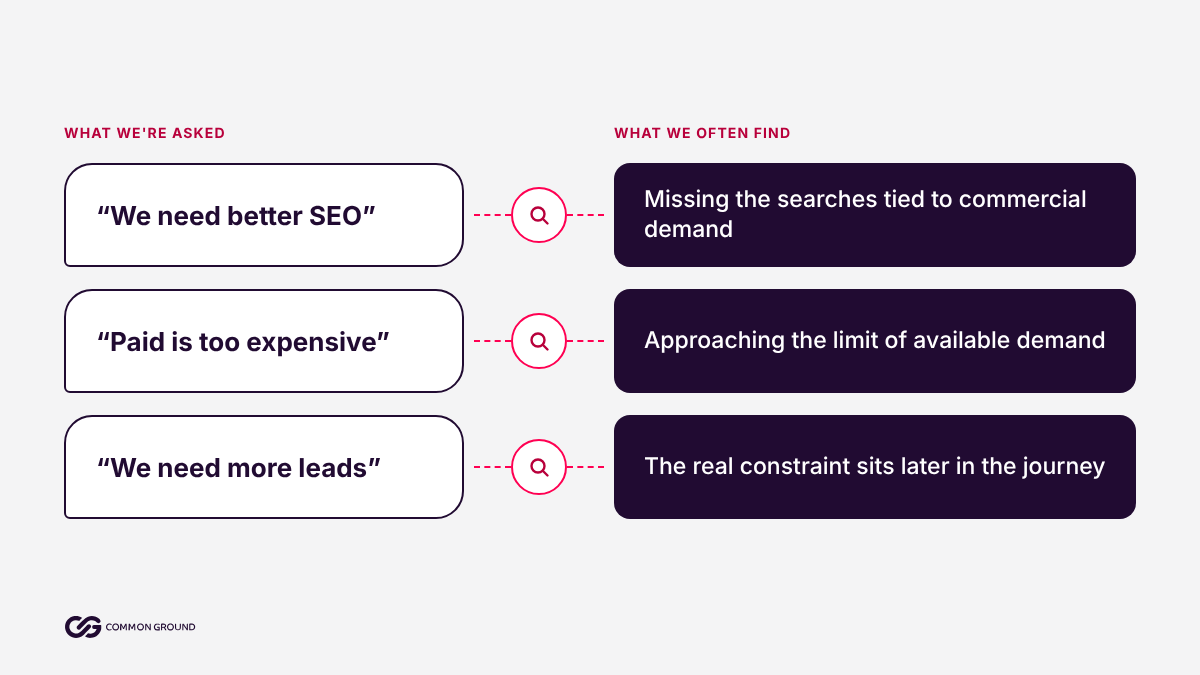
“We need to improve our SEO”
“Paid is getting too expensive”
“We need more leads”
“Our organic growth has plateaued”
There’s nothing wrong with approaching an agency with a problem you want solved. But I’ve learned to be cautious about treating the initial request as a complete diagnosis.
A business asking for more SEO might already have reasonable organic visibility, but be missing the searches most closely associated with commercial demand.
A business concerned about Paid costs might have well-managed campaigns, but be approaching the limits of the demand available within its current targeting.
And a business asking for more leads might already be attracting suitable organisations, with the real constraint appearing later in the buying journey.
Those situations call for different responses.
It’s one reason I find the early conversations with prospective clients so important. Before discussing what we could deliver, I want to understand what is actually limiting the business’s ability to generate qualified pipeline.
Five problems come up particularly often.
1. The business is visible, but not where it matters commercially
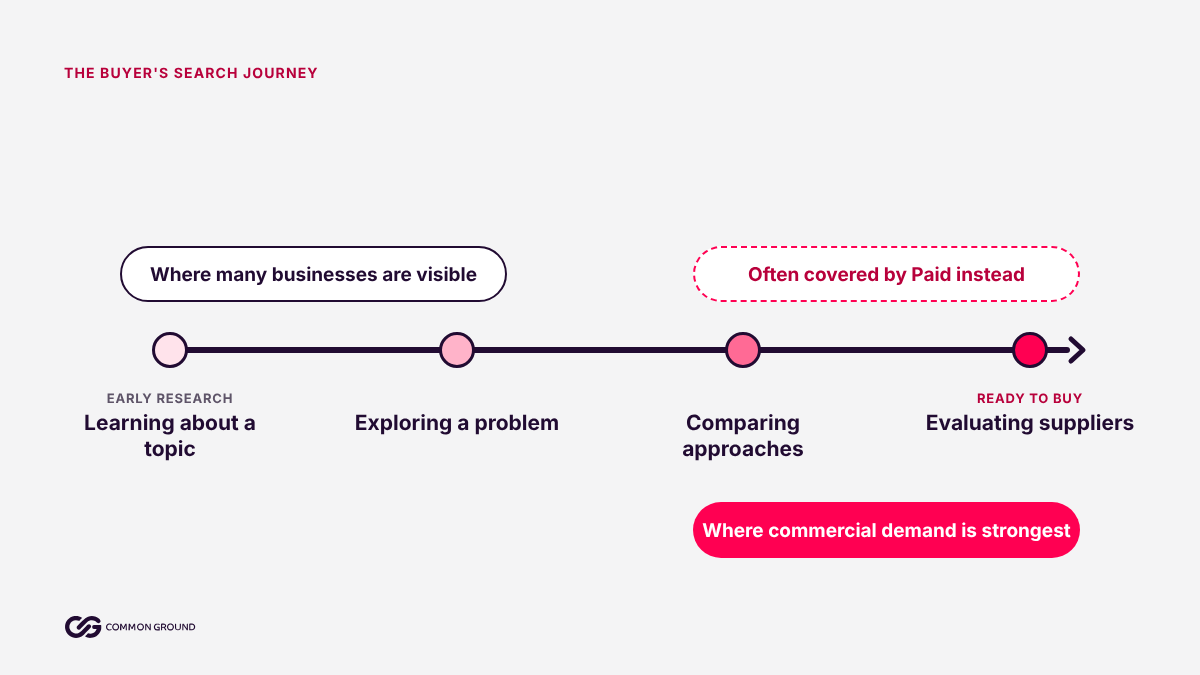
One of the first distinctions I look for is the difference between organic visibility and commercially relevant visibility.
A business can have a substantial content library, established rankings and healthy organic traffic without being particularly prominent when suitable buyers are evaluating solutions or suppliers.
That isn’t necessarily an SEO execution problem. The strategy may have been built around traffic growth, topic coverage or ranking opportunities that made sense at the time.
But when the business needs more qualified pipeline, the question changes.
Which searches indicate a problem the business can solve? Where are buyers comparing approaches or suppliers? Which competitors are visible at those moments?
And how much of that demand is the business currently missing?
This is also where the relationship between Search and Paid becomes relevant. A business may be paying to appear for commercially important searches where it has little organic presence.
That can be entirely sensible. But it should be a deliberate decision, made with the wider opportunity in view..
In most cases, the shortfall is specific: the business is under-represented where commercial demand is strongest.
2. Commercial performance is measured, but doesn’t sufficiently influence acquisition
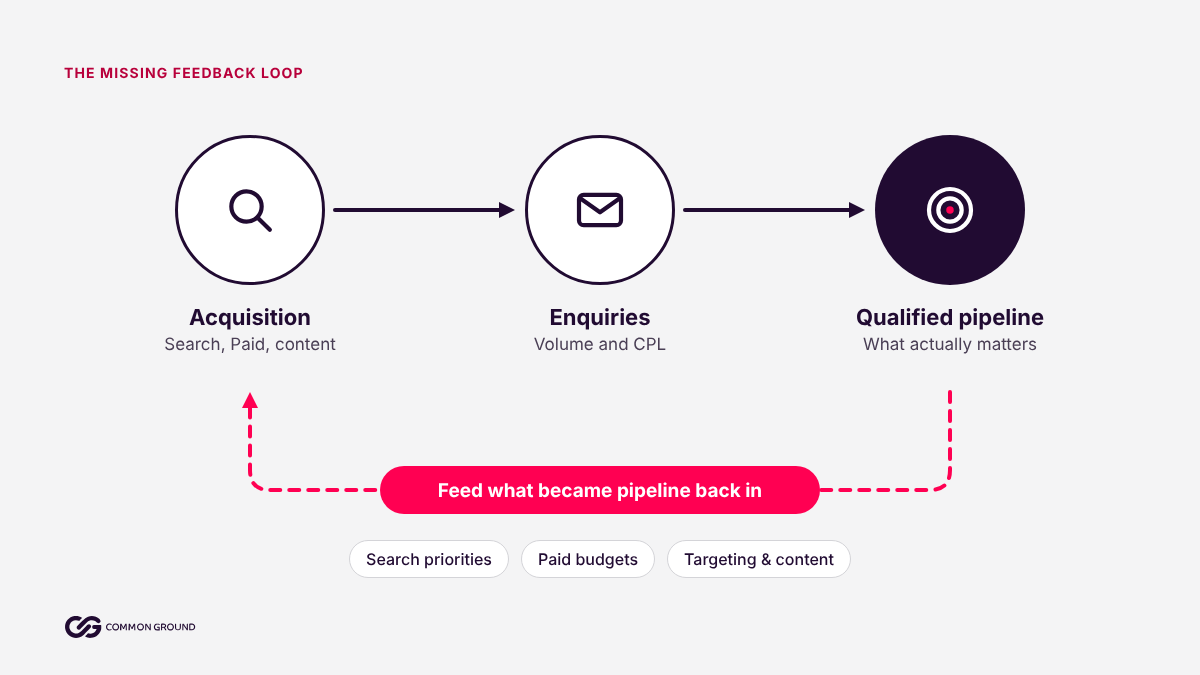
I don’t often need to explain to experienced marketing leaders that lead volume and CPL aren’t the same as commercial success.
Most understand that distinction and have some visibility of what happens after an enquiry.
The more revealing question is whether that information changes what marketing does next.
A business might report qualified opportunities by source and receive regular feedback from sales. But when Search priorities are reviewed or Paid budgets are allocated, the decisions may still be dominated by rankings, traffic, conversion volume or acquisition cost.
That’s a different problem from not having the data.
If certain search themes repeatedly contribute to valuable opportunities, I’d expect that to influence organic priorities.
If a Paid campaign generates relatively few conversions but consistently introduces the business to high-fit organisations, that should matter when evaluating its contribution.
And if particular audiences or messages generate apparent interest that rarely progresses, that should inform future targeting and content decisions.
The distinction I look for is between knowing what became pipeline and using that knowledge to improve how future pipeline is generated.
A marketing team can have sophisticated reporting without a sufficiently developed feedback loop.
What would +608% ROI look like for your brand?
That’s just one result. We’ve helped B2B brands across sectors scale SEO into real revenue, not just rankings. Want to see what’s possible?
3. Individual channels are performing, but the acquisition mix isn’t
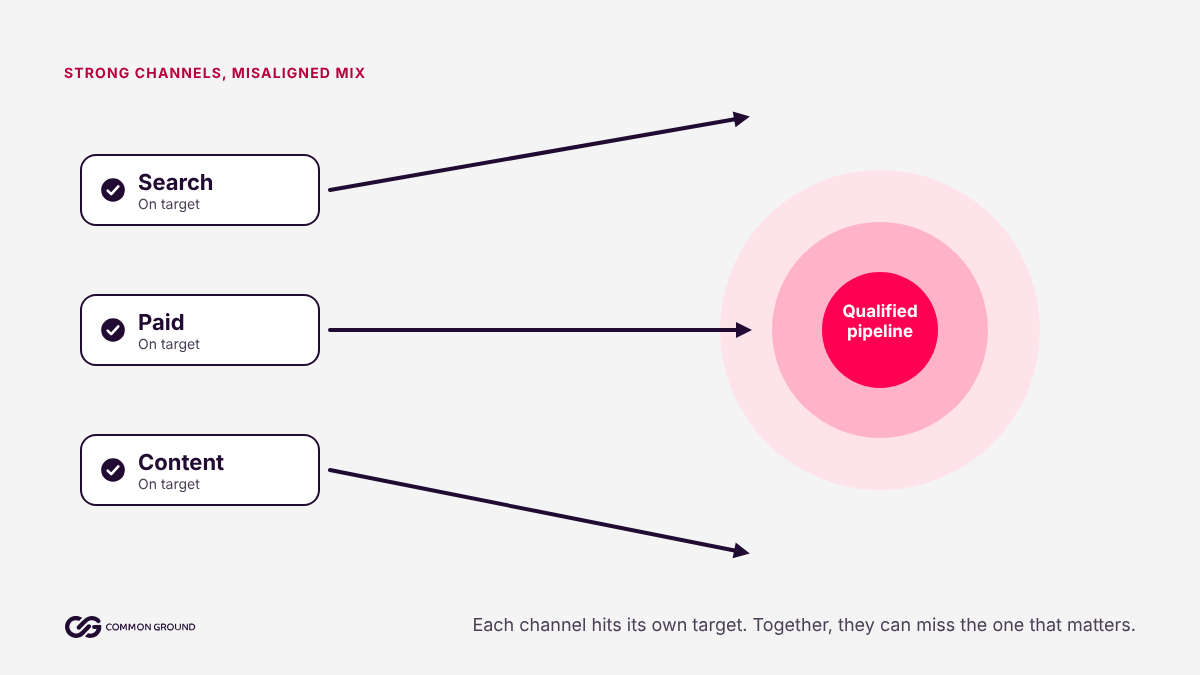
This is an interesting one because the initial conversation doesn’t always sound like a performance problem.
Search may be meeting its targets. Paid may be producing opportunities at an acceptable cost. Content may be delivered consistently.
The marketing leader can point to progress across several areas and still feel that the overall contribution to pipeline isn’t where it needs to be.
In those situations, I want to understand how decisions are made across channels as well as within them.
Who decides whether the next investment should go into improving organic visibility or increasing Paid coverage?
Are the channels targeting the same commercial priorities?
Is one compensating for a weakness in another?
And is anyone looking at the combined acquisition opportunity rather than adding together separate performance reports?
Often, the separation has developed naturally. Different specialists, agencies and internal teams have different responsibilities and targets.
That isn’t inherently wrong. Search and Paid require distinct expertise.
But strong channel management doesn’t guarantee a well-aligned acquisition strategy.
The commercial question is whether those activities are collectively capturing the right demand and contributing to qualified pipeline efficiently.
4. The acquisition strategy reflects how buyers used to research
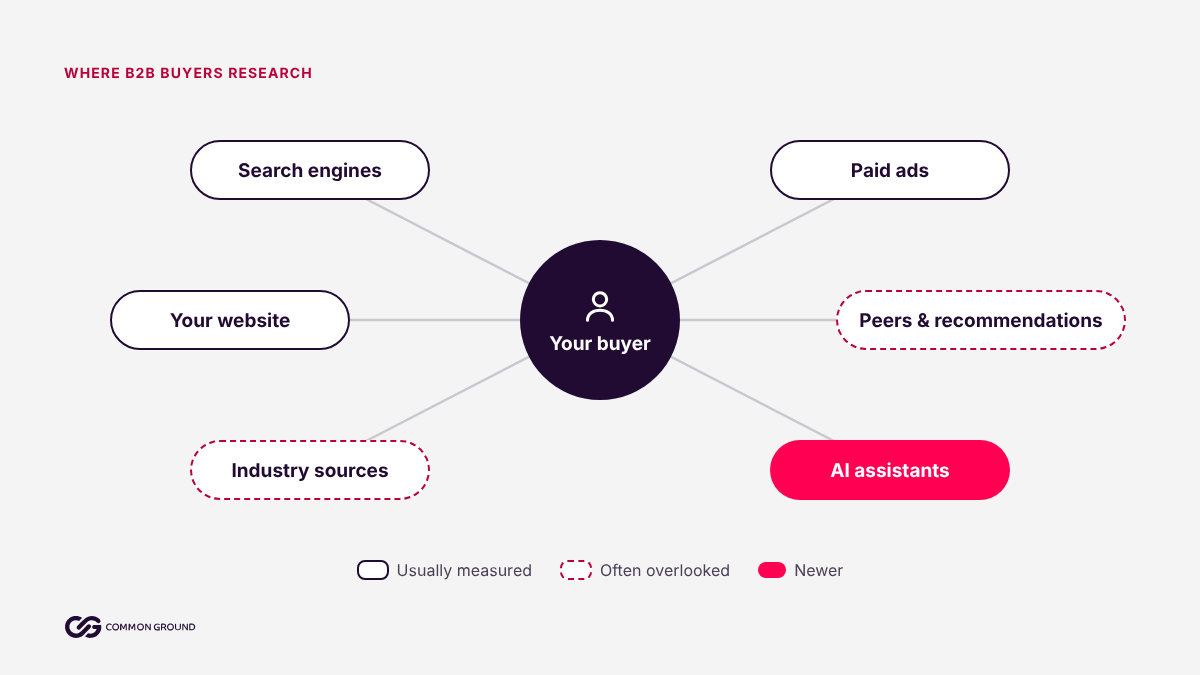
I’m increasingly interested in how businesses understand the research behaviour of their buyers.
For a long time, acquisition discussions have centred heavily on Google visibility, Paid performance and website conversions.
Those remain important. But they don’t necessarily provide a complete picture of how a business enters a buyer’s consideration.
B2B purchasing decisions have always involved multiple interactions, recommendations and sources of information. AI-assisted research now introduces another way for buyers to explore problems, evaluate approaches and potentially discover suppliers.
I don’t think that means every business should immediately invest heavily in AI Visibility.
The relevance will vary by industry, buying group and the nature of the purchase. Nor should a mention in an AI-generated answer be treated as equivalent to a qualified opportunity.
What matters is whether the business understands where its suitable buyers are researching and forming opinions.
If the acquisition strategy is based largely on historical assumptions, it may overlook meaningful changes in that behaviour.
The bigger risk is failing to notice when the way buyers discover suppliers has changed.
5. Suitable buyers are arriving, but too few become opportunities
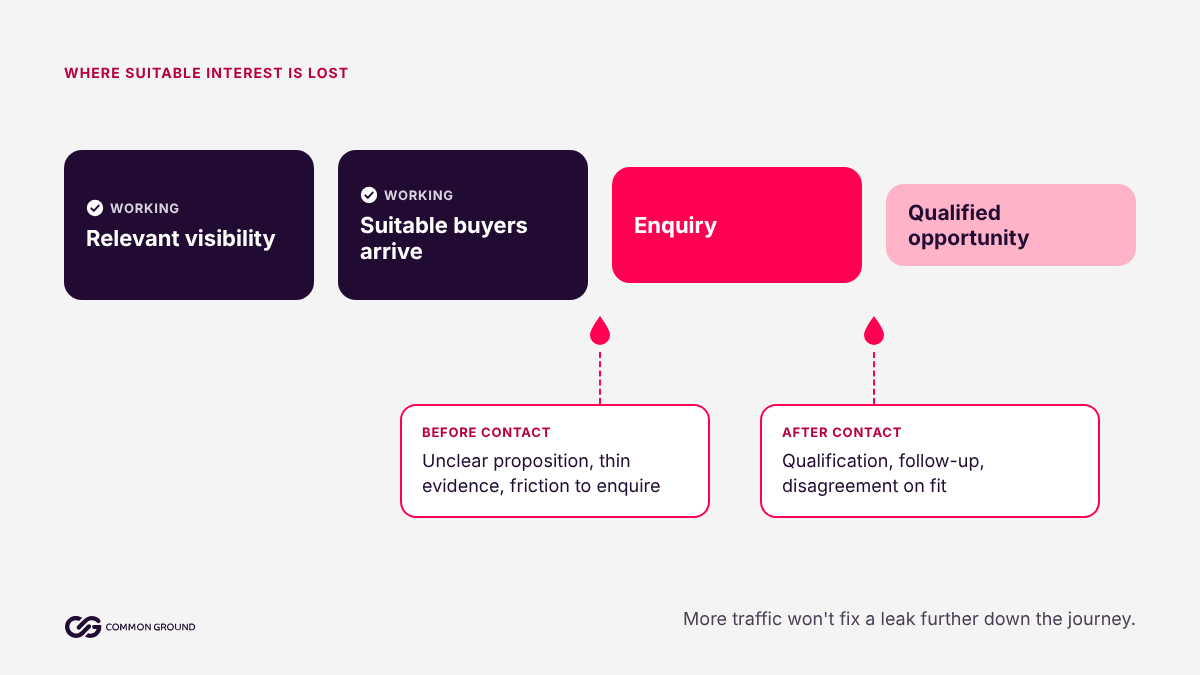
Sometimes an acquisition review reveals that the business is already attracting the right kinds of organisations.
Its visibility is relevant. Its targeting is credible. There is evidence of commercial interest.
Yet too little of that interest progresses into qualified opportunities.
At that point, I’m cautious about recommending more traffic or additional media spend.
The constraint might be an unclear proposition. Potential buyers may not find enough evidence that the business understands their requirements or has relevant experience.
The route from initial interest to enquiry might introduce unnecessary friction.
Or the problem might occur after contact, through qualification, follow-up or a mismatch between what marketing and sales consider a suitable opportunity.
Those possibilities need to be distinguished because they sit in different parts of the commercial process.
If the wrong organisations are enquiring, acquisition targeting may need attention.
If suitable organisations are enquiring but not progressing, the issue may sit elsewhere.
And if buyers aren’t making contact despite relevant interest, the website’s proposition and evaluation experience deserve scrutiny.
More acquisition activity won’t necessarily resolve a constraint that occurs after suitable demand has already been captured.
Could your brand handle 60% more conversions?
That’s one result we delivered, but it’s far from the only one. From cutting wasted spend to scaling pipeline, our PPC strategies consistently drive performance for B2B brands.
Why the first request is only a starting point
What connects these five problems is that they can produce a similar concern for the business: marketing isn’t generating enough qualified pipeline.
But the causes are different.
One business may need to capture more existing commercial demand. Another may need to use downstream performance data more effectively. Another may have an acquisition mix that has become fragmented.
Others may need to reconsider where buyers discover suppliers or understand why suitable interest isn’t progressing.
There can also be several constraints operating at once.
That’s why I’m reluctant to start an initial conversation by assuming the requested service is automatically the right solution.
If someone approaches us asking for more SEO, the answer may well be more Search investment.
If Paid is becoming expensive, campaign optimisation may be exactly what’s needed.
And if lead volume is genuinely insufficient, generating more relevant demand may be the priority.
But I’d rather establish that through a proper understanding of the business than prescribe activity based on the first symptom.
Search, Paid and AI Visibility are all ways to influence acquisition performance, in service of one objective: qualified pipeline growth.
And the most useful starting point is understanding what’s actually holding it back.
Not sure what’s holding back your B2B marketing performance?
If you’re generating activity but not enough qualified pipeline, we can help identify where the real constraints sit.
Like what you’re reading? Get it in your inbox.
Join hundreds of B2B marketers getting practical SEO, PPC, and content insights. No fluff, no spam, just smart thinking that drives results.